More on Model Validation
The model validation process happens in four steps:
Design a Set of Experiments: Define a set of experiments to be carried out on the target environment. This involves specifying the set of stimuli (input) to be applied on the target environment. Such a task is also known as the Design of Experiments (DoE).
Execute the experiments planned in step 1. on the target environment and collect the response. The combination of the input signals and the system response is referred to as the measurement dataset (or simply dataset). Due to sensors may be noisy, sampled at different rate, log intermittently, etc., you may need to clean-up your measurements dataset.
Generate Simulation Data: Conduct the exact same experiments defined in step 1 on the model and log its response and collect its response. Such a response is referred to as the simulation results.
Evaluate the Results: Assess how “close” the simulation results from step 3. are to the logged responses from step 2. using specific validation metrics.
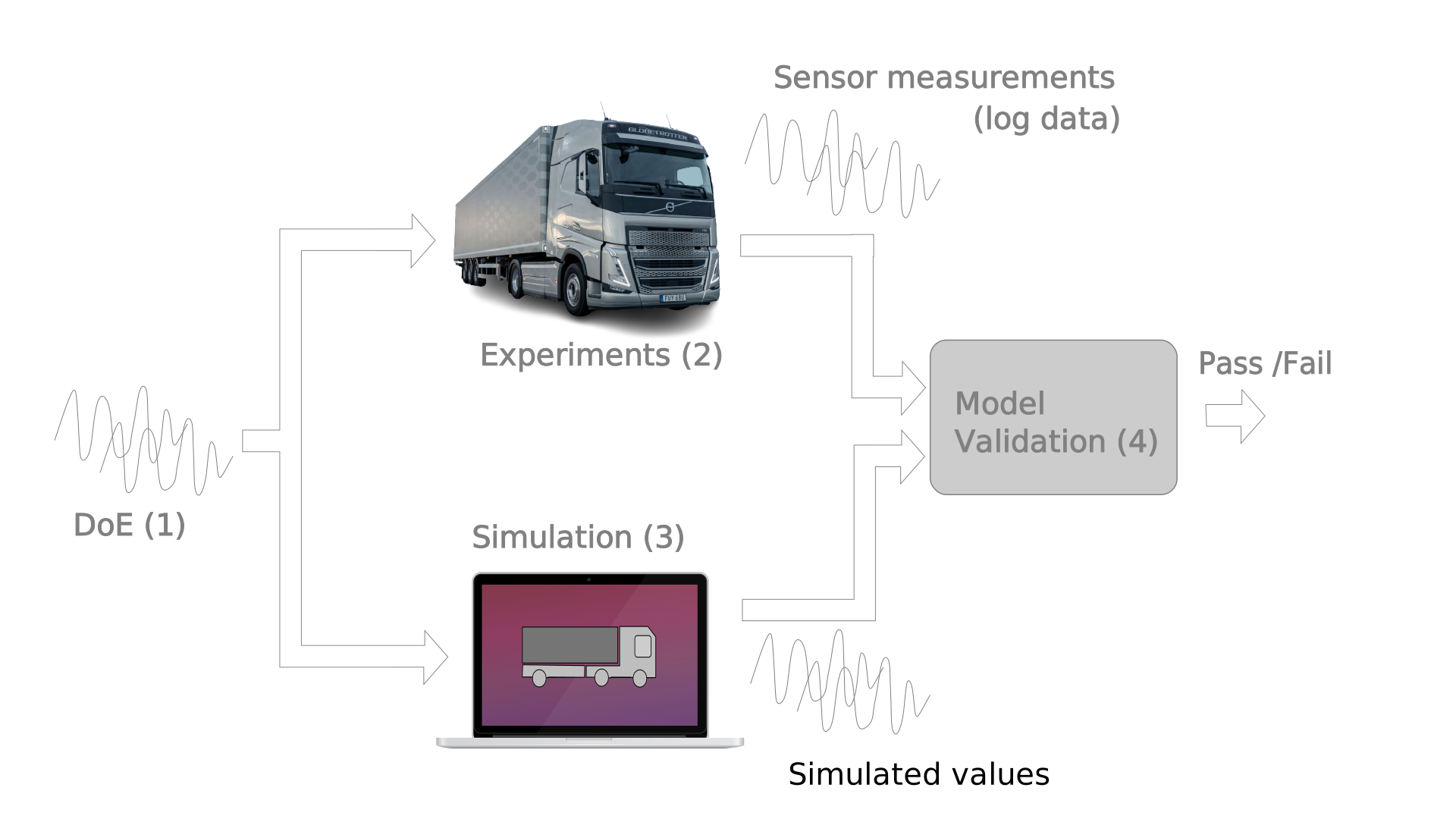
The model validation process. In this picture the validation method only returns a pass/fail value but in general it returns the evaluation of some model quality metrics.
If the results of step 4. are good, then you can trust what your model says within is validation region.
Let’s see how steps 1-4 can be applied.
Example
Assume that you are developing some cool autonomous driving algorithm that shall be deployed in a car, which represent your target environment.
Assume that your car model consider the following signals:
accelerator pedal position,
steering wheel position and
road profile,
as inputs, and the following signals:
longitudinal speed and
lateral speed.
as outputs.
Next, you want to validate your model.
Steps 1-4 are carried out in the following way:
Design of Experiment (DoE): Choose a driving route with sufficient road slope variation. Plan to take a ride on that path with a challenging driving style, including sudden accelerations and abrupt steering movements. Congratulations! You have just created a Design of Experiment (DoE).
Data Collection: Take a ride according to the plan. Log the input signals (i.e., the accelerator pedal position, the steering wheel position, and the road profile time-series) along with the output signals (i.e., longitudinal and lateral speed time-series) of the vehicle while driving. These logs represent your measurements dataset. Note how input and output are separated.
Model Simulation: Feed your model with the input signals from the measurements dataset and log your model’s output corresponding to the longitudinal and lateral vehicle speed dynamics, for which you also have the measurements data.
Comparison and Validation: Compare the longitudinal and lateral vehicle speed time-series logged during the actual drive with the simulated results using specific validation metrics.
You haven’ finished yet. In-fact, when you develop and validate a model, you should also consider the coverage region of the model along with the validation results.
If you logged data only in the accelerator pedal position range [0,40] %, the steering angle in the range [-2,2]° and the road profile was flat for all the time, then you have to deliver such an information along with your model to a potential model user.
The cost savings when using models are clear, but there is no free lunch. In fact, the challenge lies in the design of good models.